 e2d05aa8ef Redeploying an Elastic or High Availability template on Azure always
failed, so no parameter could be changed after the first deployment:
- The Master Nodes' subnets were child resources outside the virtual
network. A redeploy PUTs the virtual network with the subnets it lists,
so ARM tried to delete the Master Nodes' subnets while they were in use
(InUseSubnetCannotBeDeleted). Every subnet is now declared inside the
virtual network; the symbolic names stay as `existing` references.
- Azure Automation returns a webhook's URI only when it creates it, so the
scale-in action group got an empty serviceUri on every redeploy ('Service
Uri' must not be empty). Every deployment now creates the scale-in webhook
under a new name, from a utcNow() parameter (new on every CLI deployment)
and the deployment's name (new on every portal Redeploy, which refills the
parameters with their previous values).
- The Media Nodes' scale set no longer sets its capacity: a redeploy with a
capacity below the scale-in-protected Media Nodes running was refused. The
autoscale profile's default seeds the size at creation.
Verified live on Elastic: two redeploys in a row succeeded. A redeploy still
cannot set the autoscale minimum or maximum below the Media Nodes running
(UnsupportedCapacity); the CHANGELOG and the documentation say how to remove
them first.
|
||
|---|---|---|
| .github | ||
| docs/images | ||
| openvidu-components-angular | ||
| openvidu-dashboard | ||
| openvidu-deployment | ||
| openvidu-livekit@2f779fc1fd | ||
| openvidu-test-browsers | ||
| openvidu-test-e2e | ||
| openvidu-test-integration | ||
| openvidu-testapp | ||
| .gitignore | ||
| .gitmodules | ||
| CONTRIBUTING.md | ||
| LICENSE | ||
| NOTICE | ||
| README.md | ||
README.md







openvidu
Visit openvidu.io
What is OpenVidu?
OpenVidu is a self-hosted real-time video and audio stack, built on top of LiveKit and mediasoup, and developed by a team with over a decade of experience building WebRTC systems. It ships as two products:
OpenVidu Meet
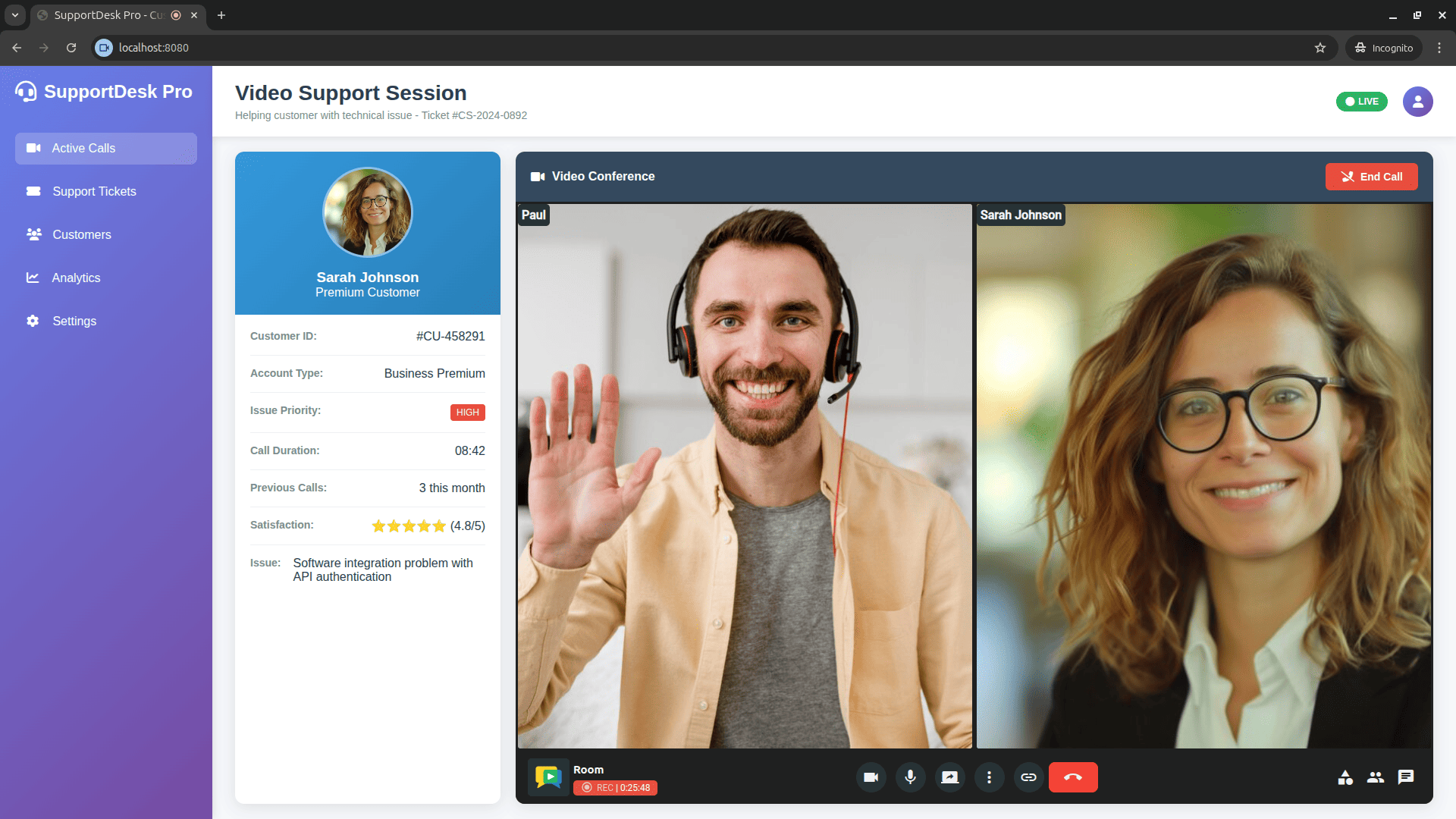
OpenVidu Meet is a ready-to-use, self-hosted video conferencing application: an open-source alternative to Zoom, Google Meet and Jitsi Meet.
Using it requires no code. You deploy it and it works — rooms, recordings, chat, screen sharing and moderation included. It is also highly customizable: brand it with your own name, logo and colours, and choose which features each participant gets.

With minimal effort it embeds into your own application, through an <iframe> or the
OpenVidu Meet web component, and is driven from your backend with a REST API and webhooks:
OpenVidu Platform
OpenVidu Platform is the programmable client and server SDKs for building custom WebRTC applications with low-level control over media, on top of LiveKit and mediasoup. It is API-compatible with LiveKit: any LiveKit client/server SDK works unchanged.
Both products
- Self-hosted only: deploy them on your own infrastructure (AWS, GCP, Azure, Oracle, DigitalOcean, on-premises). There is no hosted/SaaS tier: OpenVidu PRO is a paid, self-hosted edition, and the OpenVidu team offers support and consultancy.
- Advanced media features: recording, RTMP/streaming egress, AI agents (transcription, translation), virtual backgrounds, and more.
Getting started
- 📖 Documentation
- 🚀 Try it locally
- 💻 Tutorials
- 🎥 OpenVidu Meet — the ready-to-use video conferencing app (source)
Community Forum
Visit OpenVidu Community Forum
Contributors
This project exists thanks to all the people who contribute.

Backers
Thank you to all our backers! 🙏 [Become a backer]

Acknowledgments
OpenVidu has been supported under project "CPP2021-008720 NewGenVidu: An elastic, user-friendly and privacy-friendly videoconferencing platform", funded by MCIN/AEI/10.13039/501100011033 and by the European Union-NextGenerationEU/PRTR.

Sponsors
Support this project by becoming a sponsor. Your logo will show up here with a link to your website. [Become a sponsor]


