 dd7696e7c6 av1TrackEgressTest's L3T3 case failed in every CI run on the mediasoup engine: "Every presented packet must decode to one frame" (174 of 178, 171 of 175). The recordings are valid. The egress recorded part of the track on S1, below the top spatial layer of the sequence header. Run with frame threading (ffmpeg's default), dav1d outputs no picture for some temporal units of that part, since Matroska has no temporal delimiters to close a unit. The 4 frames missing in each file were T2 frames of the S1 part. assertHealthyVideoRecording now runs libdav1d with -max_frame_delay 1, which decodes one frame at a time, as WebRTC receivers do. Co-Authored-By: Claude Opus 5.5 <noreply@anthropic.com> |
||
|---|---|---|
| .github | ||
| docs/images | ||
| openvidu-components-angular | ||
| openvidu-dashboard | ||
| openvidu-deployment | ||
| openvidu-livekit@2f779fc1fd | ||
| openvidu-test-browsers | ||
| openvidu-test-e2e | ||
| openvidu-test-integration | ||
| openvidu-testapp | ||
| .gitignore | ||
| .gitmodules | ||
| CONTRIBUTING.md | ||
| LICENSE | ||
| NOTICE | ||
| README.md | ||
README.md







openvidu
Visit openvidu.io
What is OpenVidu?
OpenVidu is a self-hosted real-time video and audio stack, built on top of LiveKit and mediasoup, and developed by a team with over a decade of experience building WebRTC systems. It ships as two products:
OpenVidu Meet
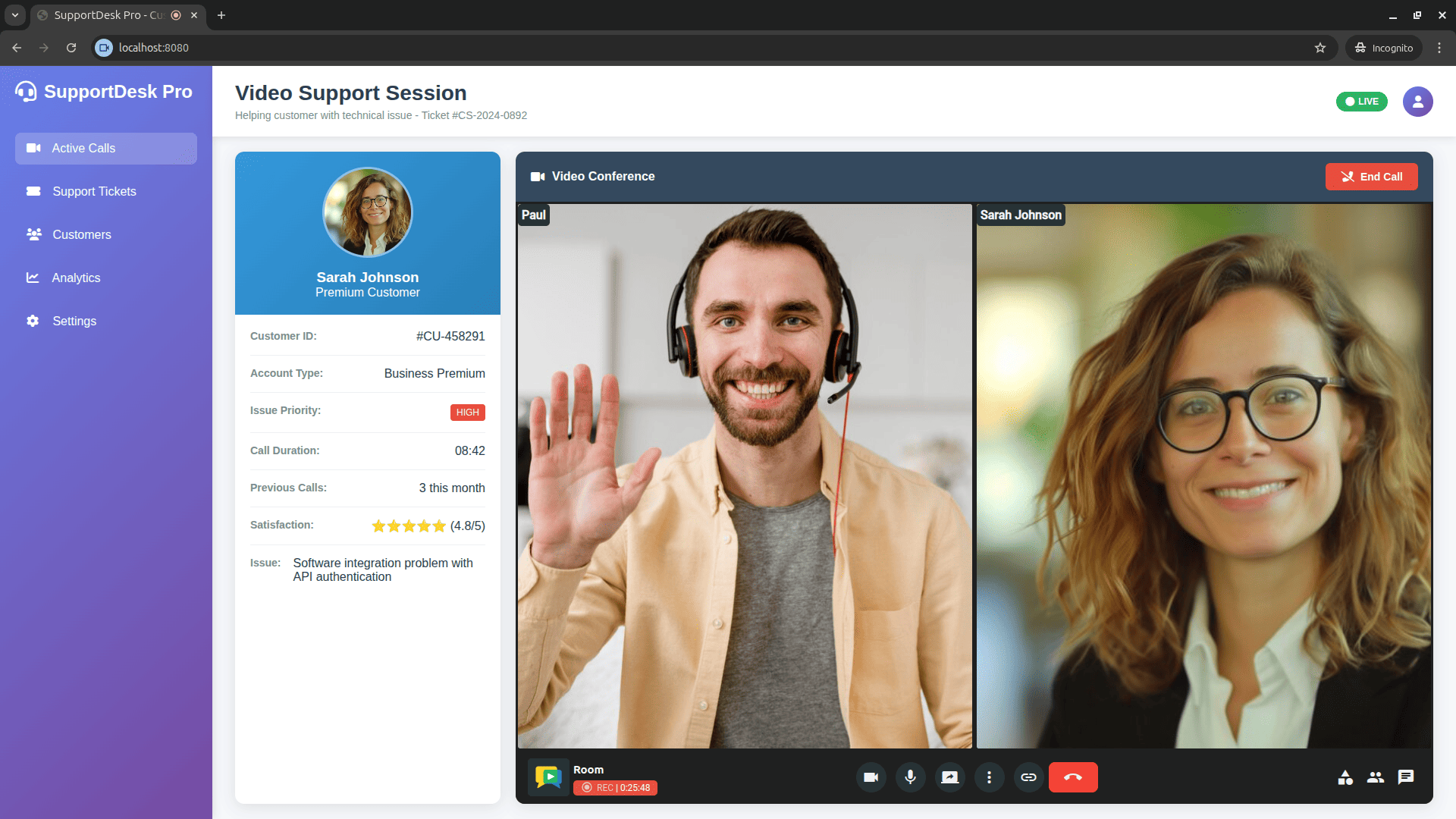
OpenVidu Meet is a ready-to-use, self-hosted video conferencing application: an open-source alternative to Zoom, Google Meet and Jitsi Meet.
Using it requires no code. You deploy it and it works — rooms, recordings, chat, screen sharing and moderation included. It is also highly customizable: brand it with your own name, logo and colours, and choose which features each participant gets.

With minimal effort it embeds into your own application, through an <iframe> or the
OpenVidu Meet web component, and is driven from your backend with a REST API and webhooks:
OpenVidu Platform
OpenVidu Platform is the programmable client and server SDKs for building custom WebRTC applications with low-level control over media, on top of LiveKit and mediasoup. It is API-compatible with LiveKit: any LiveKit client/server SDK works unchanged.
Both products
- Self-hosted only: deploy them on your own infrastructure (AWS, GCP, Azure, Oracle, DigitalOcean, on-premises). There is no hosted/SaaS tier: OpenVidu PRO is a paid, self-hosted edition, and the OpenVidu team offers support and consultancy.
- Advanced media features: recording, RTMP/streaming egress, AI agents (transcription, translation), virtual backgrounds, and more.
Getting started
- 📖 Documentation
- 🚀 Try it locally
- 💻 Tutorials
- 🎥 OpenVidu Meet — the ready-to-use video conferencing app (source)
Community Forum
Visit OpenVidu Community Forum
Contributors
This project exists thanks to all the people who contribute.

Backers
Thank you to all our backers! 🙏 [Become a backer]

Acknowledgments
OpenVidu has been supported under project "CPP2021-008720 NewGenVidu: An elastic, user-friendly and privacy-friendly videoconferencing platform", funded by MCIN/AEI/10.13039/501100011033 and by the European Union-NextGenerationEU/PRTR.

Sponsors
Support this project by becoming a sponsor. Your logo will show up here with a link to your website. [Become a sponsor]


